

On the morning of April 24, as battery-electric heavy-duty trucks and L4 autonomous heavy-duty trucks drove out of the Sinotrans Guangzhou Logistics Park, a green smart logistics corridor connecting the Guangdong-Hong Kong-Macao Greater Bay Area and the Yangtze River Delta Economic Belt — the Sinotrans "Guangdong-Shanghai" Green Transport product — was officially put into operation.
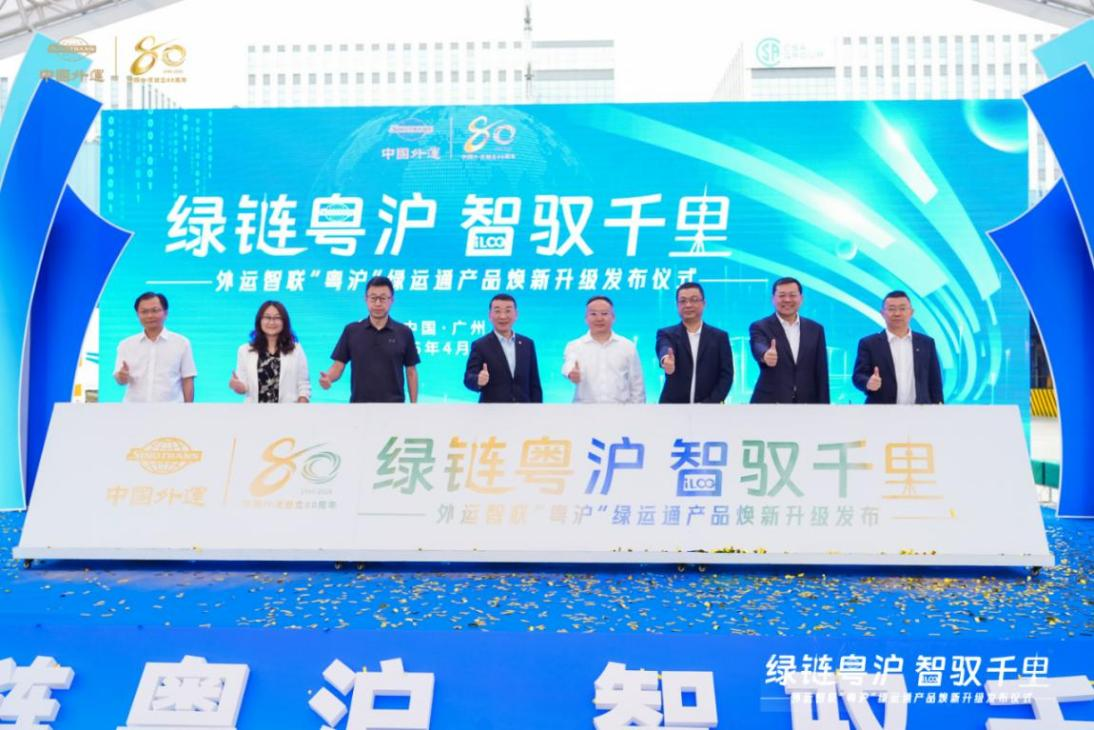
The "Guangdong-Shanghai" Green Transport is a refreshed and upgraded version of Sinotrans's Green Transport series products following the "Bay Area Cross-border" Green Transport. Based on the original service model, this product further adds L4 autonomous heavy-duty trucks, marking that Sinotrans has built a green road transport service product system with "cross-border + domestic" dual tracks running in parallel. Wang Jian, Vice President of Sinotrans, along with representatives from Guangdong provincial government departments, customers, partners, and industry associations, attended the "Guangdong-Shanghai" Green Transport product upgrading launching ceremony
A Logistics Corridor That Is Lower-Carbon and Smarter
The "Guangdong-Shanghai" Green Transport product connects the two major economic circles of the Greater Bay Area and the Yangtze River Delta, radiating to core cities such as Guangzhou, Shenzhen, Shanghai, and Suzhou. In the past, this road freight corridor spanning over 1,500 kilometers long suffered from high fuel consumption, large carbon emissions, and high cost fluctuations. Today, the "Guangdong-Shanghai" Green Transport product adopts battery-electric heavy-duty trucks and L4 autonomous heavy-duty trucks, relying on the highway recharging network along the way to realize green electricity replenishment. Vehicles depart from the Greater Bay Area and go directly to the core city clusters of the Yangtze River Delta, with door-to-door transit time within 28 hours stably.
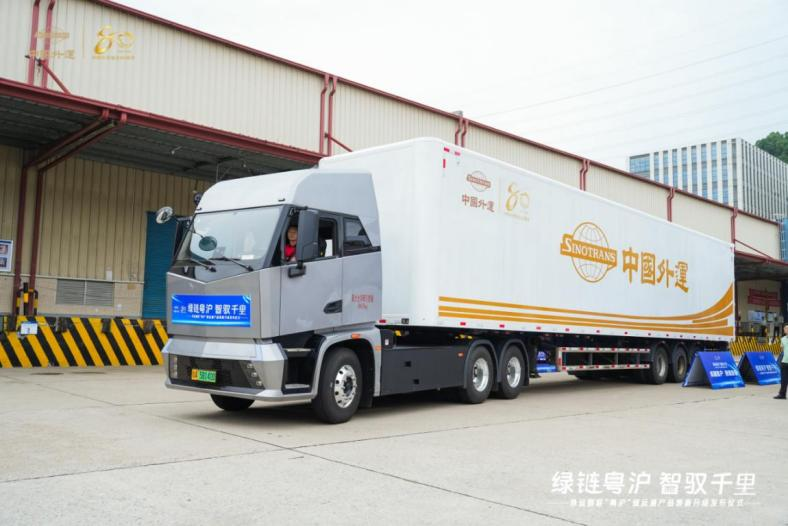
The vehicles applied in the "Guangdong-Shanghai" Green Transport product are equipped with autonomous driving systems provided by Pony.ai, a strategic partner of Sinotrans, which can realize operations such as autonomous lane changing, car following, and obstacle avoidance in highway scenarios, with reaction speed reaching millisecond level, effectively reducing safety risks caused by human fatigued driving. The autonomous heavy-duty trucks can also be linked in real time with the fleet management system, allowing customers to check cargo location and estimated time of arrival at any time, solving the problem of opaque logistics information in traditional modes. Meanwhile, the product is equipped with the carbon footprint calculator independently developed by Sinotrans, which accumulates trunk line carbon emission intensity data during transportation and can provide order-level carbon emission reports, contributing to the achievement of customers' "dual carbon" goals.
Three Fixed, One Online" Model Cracks Industry Pain Points, Allowing SMEs to Access Stable Capacity
The "Guangdong-Shanghai" Green Transport product adopts the "three fixed, one online" operation mode of "fixed point, fixed time, fixed price, and online", with punctual departure, operation according to the established route, and transparent and stable prices. This provides a more reliable option for manufacturers, trading and circulation enterprises, and SMEs troubled by freight rate fluctuations and transit delays. Whether it is consumer goods, food, alcohol and beverages, or auto parts and precision electronic products, door-to-door one-stop service can be realized through this product.
Multi-party Co-construction of Ecosystem to Promote Regional Collaborative Green Development
Sinotrans has always been committed to becoming a "practitioner and innovator in the construction of a green logistics ecosystem", jointly building a green smart logistics ecosystem with industry customers, OEMs, capacity partners, recharging network operators, financial institutions, and technology innovation enterprises. By integrating infrastructure and digital tools such as the carbon footprint calculator and intelligent dispatching system independently built by Sinotrans, as well as the highway recharging network jointly built with partners, it joins hands to promote the green development of the industrial and supply chains.
In the future, based on the successful operation of the "Bay Area Cross-border" Green Transport and the "Guangdong-Shanghai" Green Transport, Sinotrans will replicate and promote this product model to more cross-regional trunk corridors, build a national green smart road transport network, and help achieve the national "dual carbon" goals and regional collaborative development.


